
Everwide newsletter No.467

Experiment § Development of Furan Prepreg Resin
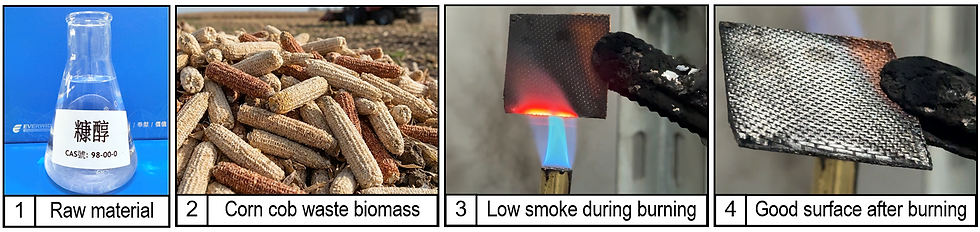
Furan resins can be produced from furfuryl alcohol (FA), which is extracted from agricultural waste such as corn cobs, making them an important material in the field of sustainable and green chemistry (Figure 1–2). After polycondensation, furan resins form a cross-linked network structure. Due to the inherent stability of the furan ring, these resins exhibit excellent resistance to acids, alkalis, solvents, and heat, and are commonly used as binders for sand cores and molds in the foundry industry. We use glass fiber fabric, carbon fiber fabric, or plant-fiber fabrics as reinforcing materials. By controlling resin content, viscosity, and drying conditions, we produce furan-resin prepregs with a slightly tacky “finger-touch” surface. After hot-press curing, the composites demonstrate strong mechanical performance. Compared with traditional phenolic resins, furan resins exhibit lower volatility and reduced gas generation, meet UL94 V-0 flammability standards, and offer high char yield and low smoke density (Figure 3–4). These advantages give furan-based prepregs strong growth potential in the energy, aerospace, fire-protection, and construction sectors. — By Mr. Jung-Hsin Lin
Activity § Visit from Douliu Junior High School

Recently, teachers and students from Douliu Junior High School visited our factory. Through this tour, we hoped to help them understand how a chemical factory actually operates and learn about the applications of adhesives in everyday life and various industries. Throughout the visit, the students were full of curiosity—actively asking questions and sharing their thoughts. While watching the dispensing process, one student exclaimed, “That drum looks so heavy, but the operator handles it so smoothly—so impressive!” When they saw the lifting equipment easily move a box, another said, “The vacuum suction principle is amazing!” During the introduction to product applications, they were surprised to learn that the black areas on wood are resin used to fill cracks or knots—something they had never noticed before. The students’ energy and genuine curiosity made the entire visit lively and enjoyable, and our colleagues truly felt the joy and fulfillment that come from teaching and sharing.
Knowledge § What Is the Principle of High-Frequency (RF) Heating?
Alternating current changes polarity several million times per second in a sinusoidal waveform. This high-frequency AC is referred to as radio-frequency (RF) or high-frequency (HF) current. When RF current passes through a coil, it generates a rapidly changing electromagnetic field, inducing eddy currents within nearby metals, which in turn generate heat. For non-conductive materials such as plastics, their molecular dipoles oscillate in response to the alternating electric field, and this dipole rotation produces heat. This type of heating—where electromagnetic energy directly penetrates the material and is converted into thermal energy through molecular friction—is known as dielectric heating, often described as the fourth heating method. Traditional heating mechanisms, such as conduction, convection, and radiation, raise the temperature from the surface inward. In contrast, high-frequency heating enables rapid and uniform volumetric heating throughout the entire material. Because of this efficiency, RF heating is widely used in metal processing, aluminum-foil sealing, plastic welding, and preheating of raw materials, among other applications.
Living § Five-Day Family Trip to Kansai

With the National Games taking place in Yunlin, elementary and junior high school students were given a 10-day break, so our family took the opportunity to fly to Japan’s Kansai region for a five-day vacation. Our journey began in Nara, with the first stop at Himuro Shrine. Its peaceful and scenic atmosphere left a deep impression on us (Figure 1). The shrine sits within a garden featuring a pond and spring cherry blossoms, and deer roam freely around Nara Park and Kasuga Taisha. From Nara, we continued to Kyoto, where we dressed in traditional kimonos and strolled around Heian Shrine (Figure 2). Walking along Ninenzaka and Sannenzaka, we passed lively shops selling Japanese sweets and matcha ice cream. After climbing flight after flight of stone steps, we finally reached Kiyomizu-dera (Figure 3). The next morning, we visited the famous Senbon Torii at Fushimi Inari Taisha. Nearby vendors sold takoyaki, grilled beef skewers, yakisoba buns, and freshly baked 10-yen bread. After a relaxing walk, we boarded a tour bus to the Rokko Garden Terrace (Figure 4), where we admired the cityscape and ocean views illuminated by the setting sun. Shops in the area offered Kobe-exclusive souvenirs—hard to resist taking home. Our final stop was Osaka Castle (Figure 5). We climbed up to the main keep and enjoyed the magnificent panoramic view, marking the perfect end to our trip. This fulfilling five-day itinerary gave us more than beautiful scenery and delicious food—it allowed us to spend quality time together, share joyful moments, and create the warmest and most precious memories. — By Mr. Wen-Cheng Tseng


Comments