
Everwide newsletter No.476

Experiment § Special Coating for PEEK Film

With the increasing adoption of high-performance engineering plastics in advanced industries, PEEK (polyether ether ketone) has been widely used in semiconductor, aerospace, medical, and automation equipment applications due to its excellent heat resistance, mechanical strength, and dimensional stability. However, the inherently low surface energy of PEEK materials presents significant challenges in adhesion processes. GC429-1 is a UV-curable resin specifically designed for PEEK films (Fig. 1). The product incorporates a “chemical anchoring” mechanism, where a photoinitiation system and free-radical reaction promote effective bonding formation on the material surface, significantly improving the adhesion between GC429-1 and PEEK films. According to customer specifications, the PEEK film is coated with GC429-1, UV-cured, and then laminated onto a glass substrate, followed by a 180-degree peel test. The results show that the initial adhesion strength is less than 10 g, and after thermal treatment at 100°C for 30 minutes, the adhesion strength remains below 30 g. After peeling, no residual adhesive is observed on the glass substrate, meeting the customer’s requirement that the coating remains on the PEEK rather than adhering to the glass (Figs. 2,3). GC429-1 demonstrates the key value of formulation design in balancing adhesion strength and functional integration. The adhesion level can be adjusted according to requirements, and the material also has potential for expansion into a wider range of applications.
– Author: Mr. Shiyao Wei
About Us § Industrial Visit – Hsilo Vocational High School

More than 60 teachers and students from the Chemical Engineering Department of Hsilo Agricultural & Industrial Vocational High School visited our facility. The visit included a production line tour, product application introduction, basic chemistry knowledge explanation, and a DIY adhesive materials experience. After the visit, the students shared their feedback: “Some adhesives can be rapidly cured through UV light irradiation, which is amazing. After an anti-fog coating is applied to the surface of a material, fogging is not easily formed even when heated. The introduction of silicone ablative materials was impressive, and it was also the first time we learned that there are rocket competitions in Taiwan. We also saw many professional instruments we had never seen before, which gave us a better understanding of the work content and environment of chemical engineering professionals.” We are glad to have shared our professionalism and enthusiasm with the students, and we look forward to making this visit a memorable learning experience for them.
Knowledge § Resins with Negative Curing Shrinkage
Thermosetting polymers form a network structure during the curing process, as monomers are connected to each other through functional groups. In most cases, the monomers move closer together during reaction, resulting in a reduction in volume, which explains the continuous shrinkage observed during curing. In a few cases, however, the reaction between functional groups increases the distance between monomers, leading to an increase in volume during curing. For example, ring-opening polymerization of cyclic monomers transforms a smaller “ring” structure into a larger “linear” structure. As a result, the curing shrinkage is lower than that of most other polymers, and may even become negative, meaning volumetric expansion. The extent of this change is related to the size of the original ring structure before reaction. Larger rings form longer linear structures after opening, resulting in less volumetric shrinkage.
Living § From Observation to Composition: Reflections on Photography
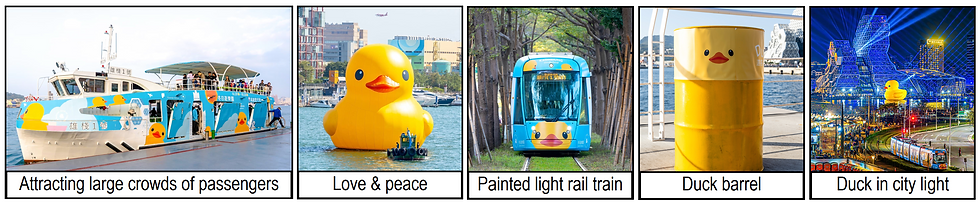
During the Lunar New Year holiday in 2024, I embarked on a “crazy chase of the Rubber Duck.” Wherever the yellow duck appeared in Kaohsiung, I followed. From the Museum LRT station, Cijin ferry, to Glory Pier, I left behind traces of my photography journey. This was not merely a record of events, but more like a photographic experiment of repeated attempts and visual thinking. After extensive shooting, I gradually came to realize that a clearly defined subject is only the basic requirement of photography. What truly differentiates the depth of an image lies in the “relationships” among the elements within the frame. The yellow duck itself has the visual advantage of high saturation and easy recognition. However, if the background is too cluttered, it can instead distract the viewer’s attention. Therefore, when photographing the largest duck at Glory Pier, I chose to step back to the Cruise Terminal, using a telephoto lens to compress the space and reorganize the composition, making the visual focus more concentrated. The photograph “The Duck in the City Light Trails” resonates because of the integration of multiple photographic elements. The yellow duck and the light rail, set against the blue night sky and harbor background, create a strong color contrast. The foreground moving light rail, the mid-ground static duck, and the background with the strongly linear Kaohsiung Music Center together form a clear spatial layering of foreground, middle ground, and background. The contrast between motion and stillness further adds depth and narrative to the image. This journey of chasing the duck has strengthened my belief that a good photograph is not accidental, but the result of repeated reflection on color, composition, and timing, as well as patient waiting. – Author: Mr. Du Guan-Ru
Thriving means working hard. Editor: Chan,Si-man/Lin,Yi-Chu Layout: Chan,Si-manE-mail:service@everwide.com.tw |


Comments